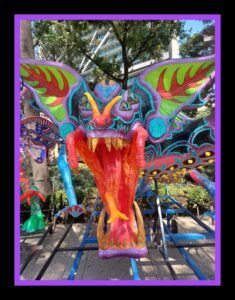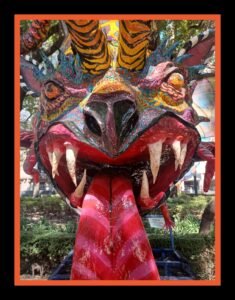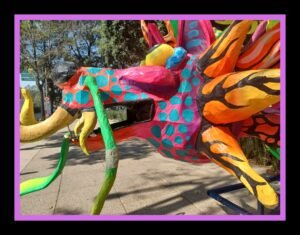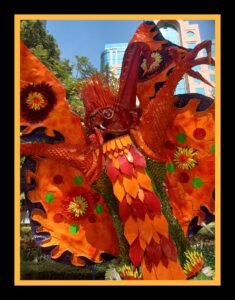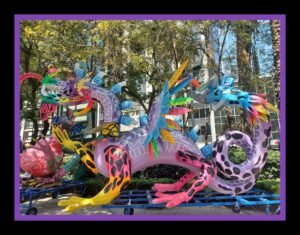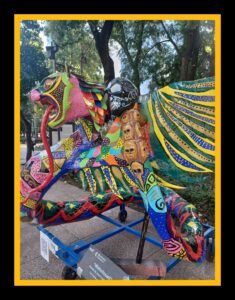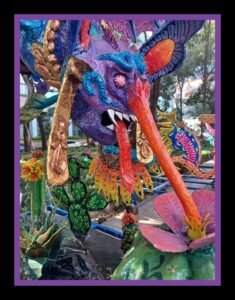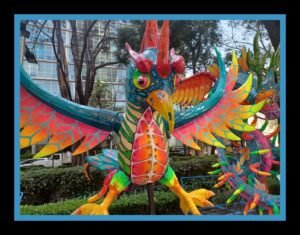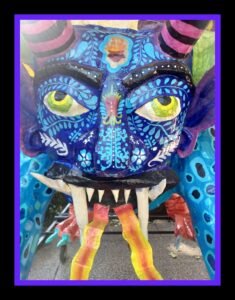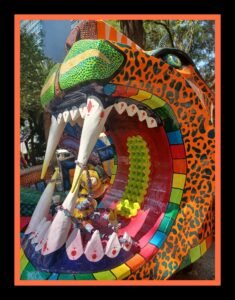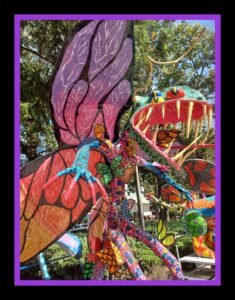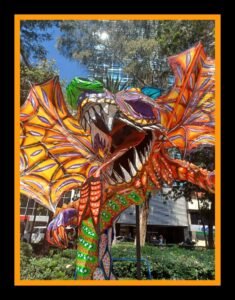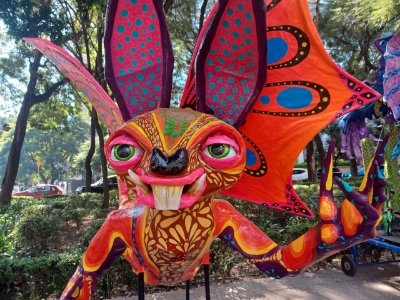
One of my highlights when visiting Mexico City in October/November 2025 was the colourful Alebrijes. Alebrijes are not traditional to the Day of the Dead; they are a modern addition dreamt up by the artist Pedro Linares in 1936. The story is that Pedro Linares, an artist living in Mexico City, became ill with peritonitis, leading to a fever which gave him some very odd dreams. In his dreams he saw images of colourful, fantastical hybrid creatures that spoke to him one word, over and over, the word “Alebrije.” This is not a word known in any language so we cannot be clear as to what it means. To my mind this event brings up the ideas of the collective unconscious found in Carl Jung’s Red Book and his meeting with the composite entity of Abraxas.
Kenneth grant was convinced that Crowley, Lovecraft and surrealist artists had all stumbled upon the same magical current as I am convinced that Pedro Linares had stumbled upon the same current as Carl Jung, in his visions of hybrid creatures. Whether anyone else buys this or not, it’s interesting how similar themes appear with people who have no connection to each other.
Having recovered from his illness Pedro Linares expressed the visions from his dreams into his art and created the first Alebrijes, making what he had discovered in his unconscious manifest for all to experience. The first Alebrijes were made from papier-mâché and later on they were made from wood. Many of these are for sale around Mexico. A vendor in one of Mexico City’s colourful markets demonstrated to me how the different pieces of wood that make up the image can be dismantled and reassembled in a different form. This nicely illustrates a core theme from chaos magick, the ability to dismantle the self, the ego, and put it back together again, in a myriad of different ways.
Over time these images have become so popular in Mexico that a few weeks prior to the Day of the Dead celebrations in Mexico City is an Alebrijes Parade of supersized sculptures from around the country. This parade, known as La Noche de los Alebrijes, had already occurred before I landed in Mexico. This is did not prevent me from seeing them, as the sculptures are on display for some weeks along one of the main streets, Paseo de la Reforma. On waking up on my first day of my Mexico trip I decided to go and see this display and I was blown away by these composite creatures with their intricate designs and bold use of colour. Reforma can get very busy during the Day of the Dead but as I arrived quite early in the morning it was quiet enough to be able to spend several hours examining this amazing display of art.
As I was looking at one of the sculptures, a local approached me clearly pleased at my very obvious admiration. He informed me that I was looking at spirit guides. I thought to myself “yes they are, they guide us to experiencing the nature of the multi-universe. By contemplating the way that they are put together and how different elements are connected we can contemplate how the multiverse is put together of seemingly disparate things into one glorious whole.” It appears that some people say they ward off evil, others that they bring good luck, others see them as good examples of Mexican Art, others say they are spirit guides. In my mind they are all these things, meaning found in the eyes of the viewer.
I don’t know much about Mexican mythology, I am a mere novice learning the best I can, inspired by my love of Santa Muerte to learn something about the culture from whence she came. Greek mythology however, I know, along with the ideas central to chaos magick. Therefore it’s not surprising that I would interpret the Alebrijes in a chaos magick/ European way. This of course means that my interpretation may bear no relevance to how a Mexican person would view them. We are all products of our own cultures and view the multiverse through the lens of our own bias, my bias being the lens of European chaos magick.
When I see a composite entity I am reminded of Hesiod’s Theogony where he says that in the beginning was chaos, and from chaos all of the gods emerged, the Great Titans who were later supplanted by the Olympians. The Titans were closer to the chaos source having emerged directly from it and if an entity was close to chaos it often took composite form. We have our Hydras, our Medusa, our Pegasus all composite in nature, all close to chaos. The Greek heroes such as Perseus were often tasked by the Olympian gods of order to destroy the composite gods of chaos, in order to create and preserve order in the Universe. We see similar themes in other pantheons, with Marduk destroying the chaos dragon Tiamat, with Yahweh’s battles with Leviathan, and Baal’s battle with Yamm. A theme is that the closer to chaos a god is the more likely they are to present as a hybrid creature representing the merging into one within chaos.
In mythology in order for the creation to be sustained, creatures needed to be become more orderly, single entity creatures, so the creatures of chaos needed to give way to the creatures of order. By contemplating a hybrid entity the chaos magician can experience a deeper connection to chaos as the hybrid creature reflects the merging of dualities into one, the place of gnosis, between the worlds.
Of course for a chaos magician the ultimate in creature of chaos would be Levi’s Baphomet, a glyph that represents all of manifested creation, often depicted in black that absorbs all the colours or in white that radiates out all colours. In Tepito one can discover him in gold which is a much better idea for a sunny climate where light bounces off the gold. While I adore the idea of Baphomet the depictions of them do not fill me with the same sense of absolute joy that I experienced that morning on Reforma, communing with the colourful, hybrid creatures of chaos. The riot of colour, the many designs, and the interesting ways in which creatures were fused together, sometimes actual known animals and plants and others with creatures from mythology such as dragons. The sculptures mirroring the joy that I feel when I contemplate the myriad of ways in which the universe unfolds. We too can reflect this by looking at new and interesting ways that we can blend the elements in our personal lives, how we can create and manifest our selves in all sorts of new combinations.
Personal metamorphism is the core practice of chaos magick and the Alebrijes remind us that we do not have to be one thing to the exclusion of another, that there are many false dichotomies in human thinking. Instead we can embrace the many, embrace the contractions and like the star of chaos manifest in all sorts of directions. Like the alchemical phrase solve and coagula we can dissolve our selves and rebuild something new and interesting in the unfolding chaotic expression of the multiverse.